Monday, November 22, 2010

Phil Ochs: Fish-Hooks


.

http://www.markmillman.com/ginsberg-ochs/images/fp19699315-06_phil_ochs.jpg

Phil Ochs, Vancouver Gardens Arena, 13 March 1969: photo by Mark Millman


There But For Fortune, the Phil Ochs documentary directed by Ken Bowser, opens in New York
in January.

The film takes us back to the folk/protest epoch of the 1960s, and follows the career of Ochs
while chronicling the major social and political events of the period (civil rights, Viet Nam & c.).

Few of which the busy troubadour Ochs, spiritual offspring of Woody Guthrie and Pete Seeger,
did not work into a song.

It's remarked by a friend, in the film, that all Phil had to do to get a song was open the New York
Times
.

Ochs' earnest sardonic lyrics, his bitter wit and biting commentary, were distinctive.

He had the voice of a crooner implanted upon a soul that was born to always be cankering about
something or other.


After some years of success, Ochs went into a bad decline, career-wise and personally. He drank
heavily. Friends feared for him.

The movie is frank, candid, unflinching on the subject of Ochs' many troubles. It's also terribly sad.

Ochs' brother Michael fearlessly confronts the issue of his brother's demons. You get the feeling
he's worked through all this before.

At a certain point about two-thirds of the way through the documentary, you get that Uh-oh, I don't
like where this is going
feeling.

A fellow "counterculture" folk singer, the poet Ed Sanders, was close with Phil.

Sanders' testimony in the film is perhaps the most affecting of the many close-up talking-heads
reports.

Ochs was only thirty-five when he went out to his sister's place in Far Rockaway and hung himself.

Sanders recounts the shock of the news.

"I went out to where he was staying, you know, where he had hung himself.

"This was a day or so after it happened. He had hung himself off, I guess, a hook on the wall. I went
out there just to look at it, to re-create it in my mind.

"It was so horrifying.

* * *

"He attracted really close friendships, and that's why people [around him] were so traumatized, and
full of angst, in his later years.

"He just couldn't stop drinking. I know it was guilt. He felt guilty, you know, about his daughter and
his marriage.

"When you make mistakes there are no time machines to rectify mistakes, so mistakes are lodged
like harpoons and fish-hooks in an intelligent person's soul.

"And I think Phil couldn't get beyond those personal harpoons that made him feel, in some ways,
worthless."


And I'm sure it wouldn't interest anybody/Outside of a small circle of friends.

-- Phil Ochs: Outside of a Small Circle of Friends, from Pleasures of the Harbor, 1967


http://web.cecs.pdx.edu/~trent/ochs/images/all-the-news.gif

Phil Ochs: All the News that's Fit to Sing (1964), front cover: image via Michael Ochs Archives

http://web.cecs.pdx.edu/~trent/ochs/images/i-aint.gif

Phil Ochs: I Ain't Marching Any More (1965), front cover: image via Michael Ochs Archives

http://www.markmillman.com/ginsberg-ochs/images/fp19699315-47_phil_ochs.jpg

Phil Ochs, Vancouver Gardens Arena, 13 March 1969: photo by Mark Millman

Raymond Williams: Individuals and Societies


.

[Mrs. Ella Watson, a government charwoman, with three grandchildren and her adopted daughter]

Mrs. Ella Watson, a government charwoman, with three grandchildren and her adopted daughter (to right, reflected in mirror): photo by Gordon Parks, August 1942 (Gordon Parks Archives, Library of Congress)


To the member, society is his own community; the members of other communities may be beyond his recognition or sympathy.

To the servant, society is an establishment, in which he finds his place.

To the rebel, a particular society is a tyranny; the alternative for which he fights is a new and better society.

To the exile, society is beyond him, but may change.

To the vagrant, society is a name for other people, who are in his way or can be used.


Preview image, see text for description

Beginning of the ball season, Berlin: photo by Carl Weinrother, 1934 (Deutsches Bundesarchiv)


Raymond Williams: Individuals and Societies (excerpt), from The Long Revolution, 1961

Saturday, November 20, 2010

Samuel Beckett: A Jar of One's Own


.

File:CanopicJarsOfNeskhons-BritishMuseum-August21-08.jpg

Canopic tomb burial jars containing the organs of Neskhons, wife of Pinedjem II; calcite, with painted wooden heads, from Deir el-Behri royal cache, c. 990-969 BC: image by Captmondo, 2008 (British Museum)


More resolutions, while we're at it. (That's right: resolutely, more resolutions.) Make abundant use of the principle of parsimony, as if it were familiar to me (it is not too late). Assume notably henceforward that the thing said and the thing heard have a common source (resisting for this purpose the temptation to call in question the possibility of assuming anything whatever). Situate this source in me (without specifying where exactly, no finicking): anything is preferable to the consciousness of third parties and (more generally speaking) of an outer world. Carry if necessary this process of compression to the point of abandoning all other postulates than that of a deaf half-wit, hearing nothing of what he says and understanding even less. Evoke at painful junctures (when discouragement threatens to raise its head) the image of a vast cretinous mouth (red, blubber and slobbering) in solitary confinement, extruding indefatigably (with a noise of wet kisses and washing in a tub) the words that obstruct it. Set aside once and for all (at the same time as the analogy with orthodox damnation) all idea of beginning and end. Overcome (that goes without saying) the fatal leaning towards expressiveness. Equate me (without pity or scruple) with him who exists (somehow, no matter how, no finicking), with him whose story this story had the brief ambition to be. Better: ascribe to me a body. Better still: arrogate to me a mind. Speak of a world of my own (sometimes referred to as the inner) without choking. Doubt no more. Seek no more. Take advantage of the brand-new soul and substantiality to abandon, with the only possible abandon, deep down within. And finally (these and other decisions having been taken) carry on cheerfully as before.

Something has changed nevertheless. Not a word about Mahood, or Worm, for the past..... Ah yes, I nearly forgot: speak of time, without flinching. And what is more, it just occurs to me (by a natural association of ideas), treat of space with the same easy grace. As if it were not bunged up on all sides, a few inches away. After all that's something - a few inches - to be thankful for. It gives one air: room for the tongue to loll, to have lolled, to loll on.


Samuel Beckett: from The Unnamable (1959)

Theodor Adorno: Dying Today


.


Street view: a series of unfortunate events #5: photo by Michael Wolf, 2010


The less subjects live anymore, the more abrupt, frightening, the death.


Street view: a series of unfortunate events #7: photo by Michael Wolf, 2010


...without power over it and ridiculous before it...


Street view: a series of unfortunate events #51: photo by Michael Wolf, 2010


Death and history... form a constellation.


Street view: a series of unfortunate events #23: photo by Michael Wolf, 2010


... the downfall of the individual brings down the entire construction of bourgeois existence along with it...


Street view: a series of unfortunate events #1: photo by Michael Wolf, 2010


Hence the constant panic in the sight of death.


Street view: a series of unfortunate events #23: photo by Michael Wolf, 2010


Death as such, or as a biological Ur-phenomenon, is not to be extracted out of the coils of history...


Street view: a series of unfortunate events #14: photo by Michael Wolf, 2010

...the form, by which the consciousness comes to grips with death,

varies along with the concrete
conditions of how one dies...


Street view: a series of unfortunate events #30: photo by Michael Wolf, 2010


What death does to what is socially condemned, is anticipated biologically in beloved human beings of great age;


Street view: a series of unfortunate events #34: photo by Michael Wolf, 2010


not only their bodies but their ego,

everything which
determines them as human beings,

crumbles without illness and violent intervention.


Street view: a series of unfortunate events #33: photo by Michael Wolf, 2010


The comforting faith, that in such disintegration or madness the core of the human being would continue to exist,
has, in its indifference towards that experience, something foolish and cynical about it.


Street view: a series of unfortunate events #35: photo by Michael Wolf, 2010


Whoever turns away from what negated their possible fulfillment, pulls a face at the metaphysical need.


Street view: a series of unfortunate events #38: photo by Michael Wolf, 2010


Theodor Adorno: Dying Today, from Negative Dialectics (1966) (edited excerpts), translated by Michael Redmond, 2001

Friday, November 19, 2010

Mirrors and Superstition


.

http://www.ibiblio.org/wm/paint/auth/velazquez/velazquez.meninas.jpg

Las Meninas (The Maids of Honour), or the Family of Philip IV: Diego Rodriguez de Silva y Velázquez, 1656-1657 (Museo del Prado, Madrid)


I'm not superstitious about mirrors.


File:Las Meninas mirror detail.jpg

Las Meninas (The Maids of Honour), or the Family of Philip IV (detail): Diego Rodriguez de Silva y Velázquez, 1656-1657 (Museo del Prado, Madrid)


But then I avoid mirrors religiously,


Las Meninas (The Maids of Honour), or the Family of Philip IV (detail): Diego Rodriguez de Silva y Velázquez, 1656-1657 (Museo del Prado, Madrid)


and I don't really know why this should be so,


Las Meninas (The Maids of Honour), or the Family of Philip IV (detail): Diego Rodriguez de Silva y Velázquez, 1656-1657 (Museo del Prado, Madrid)


for in truth there is nothing to be feared from a mirror,


Las Meninas (The Maids of Honour), or the Family of Philip IV (detail): Diego Rodriguez de Silva y Velázquez, 1656-1657 (Museo del Prado, Madrid)


perhaps it is merely because I am a religious person,


Las Meninas (The Maids of Honour), or the Family of Philip IV (detail): Diego Rodriguez de Silva y Velázquez, 1656-1657 (Museo del Prado, Madrid)


not a superstitious one,


Las Meninas (The Maids of Honour), or the Family of Philip IV (detail): Diego Rodriguez de Silva y Velázquez, 1656-1657 (Museo del Prado, Madrid)


or then again, perhaps it is because


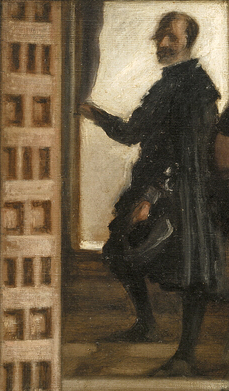
File:Meninas detail Don José Nieto Velázquez.jpg

Las Meninas (The Maids of Honour), or the Family of Philip IV (detail): Diego Rodriguez de Silva y Velázquez, 1656-1657 (Museo del Prado, Madrid)


there is so much to be feared from everything else.


London Character Shoes, business in Pittsburgh, Pennsylvania. View into mirror

London Character Shoes, Pittsburgh, Pennsylvania, view into mirror: photo by Gottso-Schleisner, Inc., 1948 (Gottscho-Schleisner Collection, Library of Congress)

Wednesday, November 17, 2010

Mirroring


.


St. Constantine's Victory over Maxentius (detail): Piero della Francesca, 1452-1466, fresco, San Francesco, Arezzo


One can almost imagine the artist lost in thought on the bridges over the Arezzo...-- Piero Bianconi, Piero della Francesca


That on the surface of the water
one should see the sky
and on the surface of the wall
one should see the sky
reflected on the surface of the water


St. Constantine's Victory over Maxentius (detail): Piero della Francesca, 1452-1466, fresco, San Francesco, Arezzo


(A recollection of Arezzo, 1964: to come out of the roaring midday sun into the cool quiet church and stare up through the scaffolding at what easily might have been a kind of heaven, slipped into the receding foreground vision at the center of The Victory of Constantine over Maxentius...)

Soft Glass


.

Glen Echo, Maryland. A view of the entrance to the midway, showing people in front of the mirrors
Glen Echo, Maryland. a view of the entrance to the midway, showing people in front of the funhouse mirrors: photo by David Myers, 1939
(Farm Security Administration/Office of War Information Collection, Library of Congress)


The passage through the looking-glass
leaves us looking back
but if there's a crack in the glass...?
Caught in transit between the two states
death and life, without
any sense of certainty which is on which
side of the glass, so that
to hold a mirror up to life may equally be
to hold a mirror up to death
thought Alice


Washington, D.C. A corner of a bedroom, probably in a rooming house for government clerks, showing reflected in a round mirror above a dresser a woman doing handwork

Washington, D.C.: corner of a bedroom in a rooming house for government clerks, with dresser mirror showing reflection of woman doing handwork: photo by David Myers, 1939 (Farm Security Administration/Office of War Information Collection, Library of Congress)