Sunday, August 7, 2011

Veins of Liquid Fire


.

http://upload.wikimedia.org/wikipedia/commons/f/f6/Arenallong.jpg

Lava flows, Arenal Volcano, Costa Rica: photo by Matthew Landry, 17 July 2008


There stood a Hill not far whose griesly top
Belch'd fire and rowling smoak; the rest entire
Shon with a glossie scurff, undoubted sign
That in his womb was hid metallic Ore,

The work of Sulphur. Thither wing'd with speed
A numerous Brigad hasten'd. As when Bands

Of Pioners with Spade and Pickax arm'd
Forerun the Royal Camp, to trench a Field,

Or cast a Rampart. Mammon led them on,
Mammon, the least erected Spirit that fell

From heav'n, for ev'n in heav'n his looks and thoughts
Were always downward bent, admiring more
The riches of Heav'ns pavement, trod'n Gold,
Then aught divine or holy else enjoy'd

In vision
beatific: by him first
Men also, and by his suggestion taught,

Ransack'd the Center, and with impious hands
Rifl'd the bowels of thir mother Earth

For Treasures better hid. Soon had his crew
Op'nd into the Hill a spacious wound
And dig'd out ribs of Gold. Let none admire
That riches grow in Hell; that soyle may best
Deserve the precious bane. And here let those

Who boast in mortal things, and wond'ring tell
Of Babel,
and the works of Memphian Kings
Learn how thir greatest Monuments of Fame,

And Strength and Art are easily out-done
By Spirits reprobate, and in an hour
What in an age they with incessant toyle
And hands innumerable scarce perform.

Nigh on the Plain in many cells prepar'd,

That underneath had veins of liquid fire
Sluc'd from the Lake, a second multitude

With wondrous Art found out the massie Ore,
Severing each kind, and scum'd the Bullion dross:

A third as soon had form'd within the ground
A various mould, and from the boyling cells
By strange conveyance fill'd each hollow nook,

As in an Organ from one blast of wind
To many a row of Pipes the sound-board breaths.


John Milton: Paradise Lost, 1674, I, 670-709


http://upload.wikimedia.org/wikipedia/commons/8/89/P%C4%81hoehoe_and_Aa_flows_at_Hawaii.jpg

Pahoehoe and ʻAʻā lava flows, side-by-side, seen from helicopter, Big Island of Hawaii: photo by Mila Zinkova, 4 September 2007


Nickel Tailings #34, Sudbury, Ontario: photo by Edward Burtynsky, 1996 (via Edward Burtynsky Photographic Works)


File:Hawaii lava flow 1.JPG

Pahoehoe lava flow, Big Island of Hawaii: photo by Mila Zinkova, 2007


Nickel Tailings #31, Sudbury, Ontario: photo by Edward Burtynsky, 1996 (via Edward Burtynsky Photographic Works)


File:Lava flow at hawaii.JPG

Pahoehoe lava flow, Big Island of Hawaii: photo by Mila Zinkova, 2007


Nickel Tailings #36, Sudbury, Ontario: photo by Edward Burtynsky, 1996 (via Edward Burtynsky Photographic Works)

File:Pāhoehoe Lava flow.JPG

Pahoehoe lava flow, Big Island of Hawaii: photo by Mila Zinkova, 2007


Nickel Tailings #35, Sudbury, Ontario: photo by Edward Burtynsky, 1996 (via Edward Burtynsky Photographic Works)

http://upload.wikimedia.org/wikipedia/commons/8/89/Ropy_pahoehoe.jpg

Close view of ropy texture forming on the surface of a
pahoehoe flow at Kilauea Volcano, Hawaii: photo by Tari Noelani Mattox, 11 June 1995 (U. S. Geological Survey)


Nickel Tailings #30, Sudbury, Ontario: photo by Edward Burtynsky, 1996 (via Edward Burtynsky Photographic Works)

Friday, August 5, 2011

Self-Replication (Edward Burtynsky: China)


.


Manufacturing #16, Bird Mobile, Ningbo, Zhejiang Province
, 2005


An exhaustive application of human logic to all available routes -- the thread
Trial and error approaches a desired solution

Ariadne's thread blindly exhausts the evolutionary search space completely, never escaping

The endless self-replication of the gene -- the organism -- the phenotype
The obsessive replication of the unit for the illusion
Of the good of the many -- to celebrate that is to celebrate

The perpetuation of the social lie, and the illusion that
Pretending the destruction of the earth
Will be for the good of many is enough,

Enough -- while knowing that it will never be enough

To ensure the immortality of the unit --
Nothing on earth will ever be enough


Manufacturing #18, Cankun Factory, Zhangzhou, Fujian Province
, 2005


China Recycling #20, Cankun Aluminum, Xiamen City, Fujian Province
, 2005


Tanggu Port, Tianjin, 2005


Manufacturing #11, Youngor Textiles, Ningbo, Zhejiang Province, 2005


Bao Steel #8, Shanghai, 2005


Urban Renewal #6, Apartment Complex, JiangjunAo, Hong Kong
, 2004


Manufacturing #2, Shift Change, Yuyuan Shoe Factory, Gaobu Town, Guangdong Province
, 2004


China Recycling #25, Cankun Aluminum, Xiamen City, Fujian Province
, 2005


Replicators are not naked genes, though they may have been when life began. Nowadays, most of them are strung along chromosomes, chromosomes are wrapped up in nuclear membranes, and nuclei are enveloped in cytoplasm and enclosed in cell membranes. Cells, in turn, are cloned to form huge assemblages which we know as organisms. Organisms are vehicles for replicators, survival machines as I have called them. But just as we had a nested hierarchy of would-be replicators -- small and large fragments of genome -- so there is a hierarchy of nested vehicles. Chromosomes and cells are gene vehicles within organisms. In many species organisms are not dispersed randomly but go around in groups. Multispecies groups form communities or ecosystems. At any of these levels the concept of vehicle is potentially applicable. Vehicle selection is the differential success of vehicles in propagating the replicators that ride inside them. In theory selection may occur at any level of the hierarchy.

.

I see the world as populated by competing replicators in germ lines. Each replicator, when compared with its alleles, can be thought of as being attached to a suite of characters, outward and visible tokens of itself. These tokens are its phenotypic consequences, in comparison with its alleles, upon the world. They determine its success or failure in continuing to exist. To a large extent the part of the world a gene can influence may happen to be limited to a local area that is sufficiently clearly bounded to be called a body, or some other discrete vehicle -- perhaps a wolf pack. But this is not necessarily so. Some of the phenotypic consequences of a replicator, when compared with its alleles, may reach across vehicle boundaries. We may have to face the complexity of regarding the biosphere as an intricate network of overlapping fields of phenotypic power. Any particular phenotypic characteristic will have to be seen as the joint product of replicators whose influence converges from many different sources, many different bodies belonging to different species, phyla, and kingdoms. This is the doctrine of the "extended phenotype."

Richard Dawkins: from Replicators and Vehicles, in Current Problems in Sociobiology, King's College Sociobiology Group, eds., Cambridge, 1982

.

The Corporate Simulating the Commonplace

And again, there's the question of the corporate vis-à-vis the common. Latin would argue that the corporate is the imagination of a body, that may or may not have conjunction with other bodies. So it's to my mind an imagination of separating or singularizing an independent entity and function. Great corporations are -- not just imaginally, but would actually seem to be -- bodies, whose value is determined by function, that do increase to the largest magnitude of their potential to incorporate. And thus they have as limit only the breakdown of the bureaucratic, or the breakdown of the infrastructure that continues a relationship between all parts of this expanding condition. So it's not a common place, although many may be inside it, or thus be experiencing it. Then again, it's frequent, and it's certainly familiar. But is it commonplace? I guess that's really the question. Is it the case that humanly one always moves to make these bodies, or these embodiments of particular authority, need or function? Because they are embodiments, and thus not just their authority but their occasion comes from what they do. Whether they employ, or create, or make things, it's not -- I mean, it's finally not that they don't have an intent to
make a car or a bottle -- but they don't necessarily have that as an end in view. They have the production of a sustaining input as their own limit.

Robert Creeley, in Tom Clark: Robert Creeley and the Genius of the American Common Place, 1993


Photos from China by Edward Burtynsky (via Edward Burtynsky Photographic Works)

Thursday, August 4, 2011

Pink Beehive


.


Manufacturing #4,
Factory Worker Dormitory, Dongguan, Guangdong Province: photo by Edward Burtynsky, 2005 (Edward Burtynsky Photographic Works)

http://upload.wikimedia.org/wikipedia/commons/d/de/Beehive.jpg

Beehive: photo by Easy n, 29 May 2010

http://upload.wikimedia.org/wikipedia/commons/9/91/Bistadet_Titania.jpg

Beehive Titania, Denmark: photo by Ole Anderson, 3 August 2007

https://blogger.googleusercontent.com/img/b/R29vZ2xl/AVvXsEgYpiGkkdbyRK-TraggAL09uV6xFz1jYZU-s6mJ7vW0LSJRMJCIfZ2QSww_yDZ-6p-eiMf_IILiKfdK_Y411ErkcqM0SoyKta43DlmFJ_EB5KfPWLWsC7eI-rLgEq4cR_ReYX10VKkndy8/s1600/IMG_3227.jpg

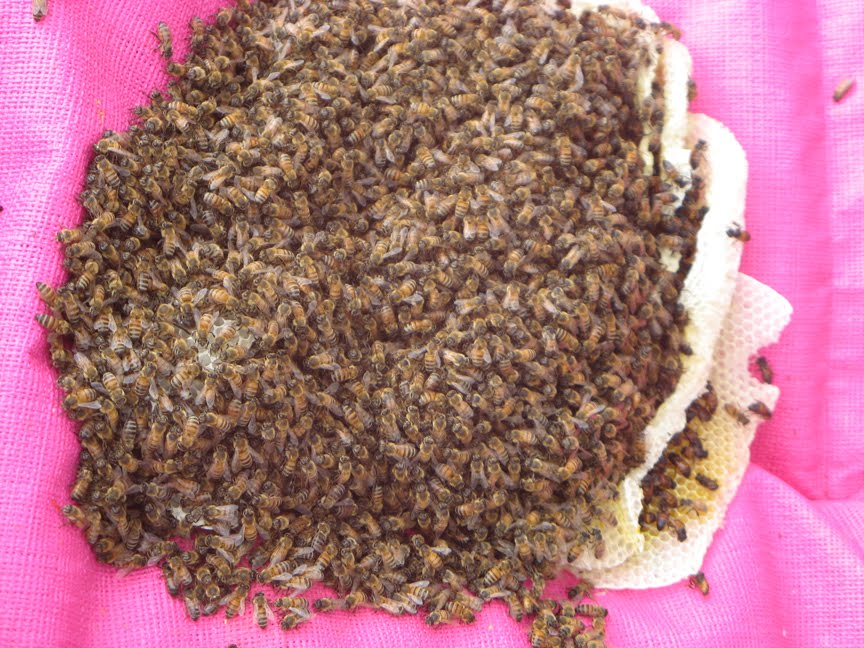
Bees collected from swimming-pool floats, Los Angeles: photo by Backwards Beekeepers, 13 April 2010


Manufacturing #17, Deda Chicken Processing Plant, Dehui City, Jilin Province
: photo by Edward Burtynsky, 2005 (Edward Burtynsky Photographic Works)

And the Rains Came


.


A woman sweeps away the muddy water at a bar following heavy rains near the U.S. military base Camp Casey in Dongducheon, South Korea, 28 July 2011: photo by Lee Jin-man/AP


Cars are trapped on a flooded road during heavy rainfall in Seoul, 27 July 2011: photo by Lim Hun-jung/Yonhap/Reuters


A bird sits on the top of a flooded bridge at an ecology park in Seoul on 29 July 2011. Torrential downfalls have severely disrupted life in Seoul and its surrounding areas, submerging streets filled with idled cars, flooding subway stations and forcing businesses to shut: photo by Lee Jin-man/AP


A man reads the Koran on the first day of Ramadan while taking shelter from rain on a sidewalk in Lahore, 2 August 2011: photo by Mohsin Raza/Reuters

Wednesday, August 3, 2011

The Maze (Edward Burtynsky: Western Australia)


.


Silver Lake Operations # 1,
Lake Lefroy, Western Australia


Hovering above the area of interest, a sense of vertigo


Silver Lake Operations # 2,
Lake Lefroy, Western Australia


Nothing specific; a circular crater, a spill of something like blood; an unlimited blank horizon


Silver Lake Operations # 3,
Lake Lefroy, Western Australia


Seen from high above and far away the alluvial stain of the maze seems to trace the flow of a prior history for which the words have not been retained


Silver Lake Operations # 8,
Lake Lefroy, Western Australia, 2007


Yet as one moves closer certain small adjustments of perspective must be made


Silver Lake Operations # 15,
Lake Lefroy, Western Australia


To accommodate the vision of the mined surface stitched and scored like a surgical wound


Tailings # 1, Kalgoorlie, Western Australia


Photos from Australia by Edward Burtynsky, 2007 (via Edward Burtynsky Photographic Works)

On the Fringes (Matt Black: Saroyan's Ghosts)


.

Matt Black photos - Saroyan's Ghosts - Abandoned restaurant. Fresno, California.

Abandoned restaurant, Fresno, California


At the end, souls barely touch down
on the ghost town streets
as they drift toward forgetting
on an oneiric wind


Matt Black photos - Saroyan's Ghosts - Bicyclist on empty street. Fresno, California.

Bicyclist on empty street, Fresno, California

Photos by Matt Black, from Saroyan's Ghosts, 2011

Monday, August 1, 2011

Constantine P. Cavafy: The God Abandons Antony


.


When suddenly, at midnight, you hear
an invisible procession going by
with exquisite music, voices,
don’t mourn your luck that’s failing now,
your work that failed, your life's plans
all proving deceptive -- don’t mourn them uselessly.
As one long prepared, and graced with courage,
say goodbye to her, the Alexandria that is leaving.
Above all, don’t fool yourself, don’t say
it was a dream, your ears deceived you:
don’t degrade yourself with empty hopes like these.
As one long prepared, and graced with courage,
as is right for you who proved worthy of this kind of city,
go firmly to the window
and listen with deep emotion, but not
with the whining, the pleas of a coward;
listen -- your final delectation -- to the voices,
to the exquisite music of that strange procession,
and say goodbye to her, to the Alexandria you are losing.


C. P. Cavafy (1863-1933): The God Abandons Antony, 1911, trans. by Edmund Keeley and Philip Sherrard, 1992


Απολείπειν ο θεός Aντώνιον Αναγνωρισμένα


Σαν έξαφνα, ώρα μεσάνυχτ’, ακουσθεί
αόρατος θίασος να περνά
με μουσικές εξαίσιες, με φωνές—
την τύχη σου που ενδίδει πια, τα έργα σου
που απέτυχαν, τα σχέδια της ζωής σου
που βγήκαν όλα πλάνες, μη ανωφέλετα θρηνήσεις.
Σαν έτοιμος από καιρό, σα θαρραλέος,
αποχαιρέτα την, την Aλεξάνδρεια που φεύγει.
Προ πάντων να μη γελασθείς, μην πεις πως ήταν
ένα όνειρο, πως απατήθηκεν η ακοή σου·
μάταιες ελπίδες τέτοιες μην καταδεχθείς.
Σαν έτοιμος από καιρό, σα θαρραλέος,
σαν που ταιριάζει σε που αξιώθηκες μια τέτοια πόλι,
πλησίασε σταθερά προς το παράθυρο,
κι άκουσε με συγκίνησιν, αλλ’ όχι
με των δειλών τα παρακάλια και παράπονα,
ως τελευταία απόλαυσι τους ήχους,
τα εξαίσια όργανα του μυστικού θιάσου,
κι αποχαιρέτα την, την Aλεξάνδρεια που χάνεις.


(Από τα Ποιήματα 1897-1933, Ίκαρος 1984)


And now Antony once more sent Caesar a challenge to single combat. But Caesar answered that Antony had many ways of dying. Then Antony, conscious that there was no better death for him than that by battle, determined to attack by land and sea at once. And at supper, we are told, he bade the slaves pour out for him and feast him more generously; for it was uncertain, he said, whether they would be doing this on the morrow, or whether they would be serving other masters, while he himself would be lying dead, a mummy and a nothing. Then, seeing that his friends were weeping at these words, he declared that he would not lead them out to battle, since from it he sought an honourable death for himself rather than safety and victory.

During this night, it is said, about the middle of it, while the city was quiet and depressed through fear and expectation of what was coming, suddenly certain harmonious sounds from all sorts of instruments were heard, and the shouting of a throng, accompanied by cries of Bacchic revelry and satyric leapings, as if a troop of revellers, making a great tumult, were going forth from the city; and their course seemed to lie about through the middle of the city toward the outer gate which faced the enemy, at which point the tumult became loudest and then dashed out. Those who sought the meaning of the sign were of the opinion that the god to whom Antony always most likened and attached himself was now deserting him.


Plutarch (c. 46-120 AD): from The Life of Marcus Antonius in Parallel Lives, late 1st c, trans. by Bernadotte Perrin in the Loeb Classics Series, 1920


The Banquet of Cleopatra (details)
: Giovanni Battista Tiepolo, 1746-7 (Palazzo Labia, Venice)