Tuesday, May 3, 2011

Oscar Wilde: The Nightingale and the Rose


.


Rose and nightingale (gul-o-bul-bul): Qajar, Iran, 19th century (Metropolitan Museum of Art)


"She said that she would dance with me if I brought her red roses," cried the young Student; "but in all my garden there is no red rose."

From her nest in the holm-oak tree the Nightingale heard him, and she looked out through the leaves, and wondered.

"No red rose in all my garden!" he cried, and his beautiful eyes filled with tears. "Ah, on what little things does happiness depend! I have read all that the wise men have written, and all the secrets of philosophy are mine, yet for want of a red rose is my life made wretched."

"Here at last is a true lover," said the Nightingale. "Night after night have I sung of him, though I knew him not: night after night have I told his story to the stars, and now I see him. His hair is dark as the hyacinth-blossom, and his lips are red as the rose of his desire; but passion has made his face like pale ivory, and sorrow has set her seal upon his brow."

"The Prince gives a ball tomorrow night," murmured the young Student, "and my love will be of the company. If I bring her a red rose she will dance with me till dawn. If I bring her a red rose, I shall hold her in my arms, and she will lean her head upon my shoulder, and her hand will be clasped in mine. But there is no red rose in my garden, so I shall sit lonely, and she will pass me by. She will have no heed of me, and my heart will break."

"Here indeed is the true lover," said the Nightingale. "What I sing of, he suffers -- what is joy to me, to him is pain. Surely Love is a wonderful thing. It is more precious than emeralds, and dearer than fine opals. Pearls and pomegranates cannot buy it, nor is it set forth in the marketplace. It may not be purchased of the merchants, nor can it be weighed out in the balance for gold."

"The musicians will sit in their gallery," said the young Student, "and play upon their stringed instruments, and my love will dance to the sound of the harp and the violin. She will dance so lightly that her feet will not touch the floor, and the courtiers in their gay dresses will throng round her. But with me she will not dance, for I have no red rose to give her"; and he flung himself down on the grass, and buried his face in his hands, and wept.

"Why is he weeping?" asked a little Green Lizard, as he ran past him with his tail in the air.

"Why, indeed?" said a Butterfly, who was fluttering about after a sunbeam.

"Why, indeed?" whispered a Daisy to his neighbour, in a soft, low voice.

"He is weeping for a red rose," said the Nightingale.

"For a red rose?" they cried; "how very ridiculous!" and the little Lizard, who was something of a cynic, laughed outright.

But the Nightingale understood the secret of the Student's sorrow, and she sat silent in the oak-tree, and thought about the mystery of Love.

Suddenly she spread her brown wings for flight, and soared into the air. She passed through the grove like a shadow, and like a shadow she sailed across the garden.

In the centre of the grass-plot was standing a beautiful Rose-tree, and when she saw it she flew over to it, and lit upon a spray.

"Give me a red rose," she cried, "and I will sing you my sweetest song."

But the Tree shook its head.

"My roses are white," it answered; "as white as the foam of the sea, and whiter than the snow upon the mountain. But go to my brother who grows round the old sun-dial, and perhaps he will give you what you want."

So the Nightingale flew over to the Rose-tree that was growing round the old sun-dial.

"Give me a red rose," she cried, "and I will sing you my sweetest song."

But the Tree shook its head.

"My roses are yellow," it answered; "as yellow as the hair of the mermaiden who sits upon an amber throne, and yellower than the daffodil that blooms in the meadow before the mower comes with his scythe. But go to my brother who grows beneath the Student's window, and perhaps he will give you what you want."

So the Nightingale flew over to the Rose-tree that was growing beneath the Student's window.

"Give me a red rose," she cried, "and I will sing you my sweetest song."

But the Tree shook its head.

"My roses are red," it answered, "as red as the feet of the dove, and redder than the great fans of coral that wave and wave in the ocean-cavern. But the winter has chilled my veins, and the frost has nipped my buds, and the storm has broken my branches, and I shall have no roses at all this year."

"One red rose is all I want," cried the Nightingale, "only one red rose! Is there no way by which I can get it?"

"There is a way," answered the Tree; "but it is so terrible that I dare not tell it to you."

"Tell it to me," said the Nightingale, "I am not afraid."

"If you want a red rose," said the Tree, "you must build it out of music by moonlight, and stain it with your own heart's-blood. You must sing to me with your breast against a thorn. All night long you must sing to me, and the thorn must pierce your heart, and your life-blood must flow into my veins, and become mine."

"Death is a great price to pay for a red rose," cried the Nightingale, "and Life is very dear to all. It is pleasant to sit in the green wood, and to watch the Sun in his chariot of gold, and the Moon in her chariot of pearl. Sweet is the scent of the hawthorn, and sweet are the bluebells that hide in the valley, and the heather that blows on the hill. Yet Love is better than Life, and what is the heart of a bird compared to the heart of a man?"

So she spread her brown wings for flight, and soared into the air. She swept over the garden like a shadow, and like a shadow she sailed through the grove.

The young Student was still lying on the grass, where she had left him, and the tears were not yet dry in his beautiful eyes.

"Be happy," cried the Nightingale, "be happy; you shall have your red rose. I will build it out of music by moonlight, and stain it with my own heart's-blood. All that I ask of you in return is that you will be a true lover, for Love is wiser than Philosophy, though she is wise, and mightier than Power, though he is mighty. Flame-coloured are his wings, and coloured like flame is his body. His lips are sweet as honey, and his breath is like frankincense."

The Student looked up from the grass, and listened, but he could not understand what the Nightingale was saying to him, for he only knew the things that are written down in books.

But the Oak-tree understood, and felt sad, for he was very fond of the little Nightingale who had built her nest in his branches.

"Sing me one last song," he whispered; "I shall feel very lonely when you are gone."

So the Nightingale sang to the Oak-tree, and her voice was like water bubbling from a silver jar.

When she had finished her song the Student got up, and pulled a note-book and a lead-pencil out of his pocket.

"She has form," he said to himself, as he walked away through the grove -- "that cannot be denied to her; but has she got feeling? I am afraid not. In fact, she is like most artists; she is all style, without any sincerity. She would not sacrifice herself for others. She thinks merely of music, and everybody knows that the arts are selfish. Still, it must be admitted that she has some beautiful notes in her voice. What a pity it is that they do not mean anything, or do any practical good." And he went into his room, and lay down on his little pallet-bed, and began to think of his love; and, after a time, he fell asleep.

And when the Moon shone in the heavens the Nightingale flew to the Rose-tree, and set her breast against the thorn. All night long she sang with her breast against the thorn, and the cold crystal Moon leaned down and listened. All night long she sang, and the thorn went deeper and deeper into her breast, and her life-blood ebbed away from her.

She sang first of the birth of love in the heart of a boy and a girl. And on the top-most spray of the Rose-tree there blossomed a marvellous rose, petal following petal, as song followed song. Pale was it, at first, as the mist that hangs over the river -- pale as the feet of the morning, and silver as the wings of the dawn. As the shadow of a rose in a mirror of silver, as the shadow of a rose in a water-pool, so was the rose that blossomed on the topmost spray of the Tree.

But the Tree cried to the Nightingale to press closer against the thorn. "Press closer, little Nightingale," cried the Tree, "or the Day will come before the rose is finished."

So the Nightingale pressed closer against the thorn, and louder and louder grew her song, for she sang of the birth of passion in the soul of a man and a maid.

And a delicate flush of pink came into the leaves of the rose, like the flush in the face of the bridegroom when he kisses the lips of the bride. But the thorn had not yet reached her heart, so the rose's heart remained white, for only a Nightingale's heart's-blood can crimson the heart of a rose.

And the Tree cried to the Nightingale to press closer against the thorn. "Press closer, little Nightingale," cried the Tree, "or the Day will come before the rose is finished."

So the Nightingale pressed closer against the thorn, and the thorn touched her heart, and a fierce pang of pain shot through her. Bitter, bitter was the pain, and wilder and wilder grew her song, for she sang of the Love that is perfected by Death, of the Love that dies not in the tomb.

And the marvellous rose became crimson, like the rose of the eastern sky. Crimson was the girdle of petals, and crimson as a ruby was the heart.

But the Nightingale's voice grew fainter, and her little wings began to beat, and a film came over her eyes. Fainter and fainter grew her song, and she felt something choking her in her throat.

Then she gave one last burst of music. The white Moon heard it, and she forgot the dawn, and lingered on in the sky. The red rose heard it, and it trembled all over with ecstasy, and opened its petals to the cold morning air. Echo bore it to her purple cavern in the hills, and woke the sleeping shepherds from their dreams. It floated through the reeds of the river, and they carried its message to the sea.

"Look, look!" cried the Tree, "the rose is finished now"; but the Nightingale made no answer, for she was lying dead in the long grass, with the thorn in her heart.

And at noon the Student opened his window and looked out.

"Why, what a wonderful piece of luck!" he cried; "here is a red rose! I have never seen any rose like it in all my life. It is so beautiful that I am sure it has a long Latin name"; and he leaned down and plucked it.

Then he put on his hat, and ran up to the Professor's house with the rose in his hand.

The daughter of the Professor was sitting in the doorway winding blue silk on a reel, and her little dog was lying at her feet.

"You said that you would dance with me if I brought you a red rose," cried the Student. "Here is the reddest rose in all the world. You will wear it tonight next your heart, and as we dance together it will tell you how I love you."

But the girl frowned.

"I am afraid it will not go with my dress," she answered; "and, besides, the Chamberlain's nephew has sent me some real jewels, and everybody knows that jewels cost far more than flowers."

"Well, upon my word, you are very ungrateful," said the Student angrily; and he threw the rose into the street, where it fell into the gutter, and a cart-wheel went over it.

"Ungrateful!" said the girl. "I tell you what, you are very rude; and, after all, who are you? Only a Student. Why, I don't believe you have even got silver buckles to your shoes as the Chamberlain's nephew has"; and she got up from her chair and went into the house.

"What a silly thing Love is," said the Student as he walked away. "It is not half as useful as Logic, for it does not prove anything, and it is always telling one of things that are not going to happen, and making one believe things that are not true. In fact, it is quite unpractical, and, as in this age to be practical is everything, I shall go back to Philosophy and study Metaphysics."

So he returned to his room and pulled out a great dusty book, and began to read.


http://upload.wikimedia.org/wikipedia/commons/7/72/PomegranateTree.jpg

Pomegranate (Punica granatum) on tree, Shiraz, Iran: photo by Kevin Payravi, 3 July 2008


When its thorns pierced the heart of the nightingale, the rose wept.


Roses, Shiraz Botanical Garden, Iran: photo by Nick Taylor, 4 May 2008


The gul-o-bul-bul, or rose and nightingale, motif was employed in both Persian literature and painting. In poetry, the two stood in for the beloved and the loved, entwined in either an earthly or divine union. In art, the motif appeared on all types of objects, and during the Qajar period proliferated to the extent that it came practically to symbolize the country itself.

Oscar Wilde: The Nightingale and the Rose, from The Happy Prince and Other Tales, 1888

Monday, May 2, 2011

W. H. Hudson: A Nightingale


.


Orange Billed Nightingale-Thrush (Catharus aurantilrostris), Finca Las Nieves, in the cloud forest above Puerto Escondido, Mexico: photo by Michael Shepherd, 19 February 2008


I did not see the cat at first, but have no doubt that the nightingale had seen and knew that it was there. High up on the tops of the thorn, a couple of sparrows were silently perched. Perhaps, like myself, they had come there to listen. After I had been standing motionless, drinking in that dulcet music for at least five minutes, one of the two sparrows dropped from the perch straight down, and alighting on the bare wet ground directly under the nightingale, began busily pecking at something eatable it had discovered. No sooner had he begun pecking than out leaped the concealed cat on to him. The sparrow fluttered wildly up from beneath or between the claws, as if by a miracle.The cat glared round, and, catching sight of me close by, sprang back into the hedge and was gone. But all this time the exposed nightingale, perched only five feet above the spot where the attack had been made and the sparrow had so nearly lost his life, had continued singing; and he sang on for some minutes after. I suppose that he had seen the cat before, and knew instinctively that he was beyond its reach; that it was a terrestrial, not an aerial enemy, and so feared it not at all; and he would, perhaps, have continued singing if the sparrow had been caught and instantly killed.

Quite early in June I began to feel just a little cross with the nightingales, for they almost ceased singing; and considering that the spring had been a backward one, it seemed to me that their silence was coming too soon. I was not sufficiently regardful of the fact that their lays are solitary, as the poet has said; that they ask for no witness of their song, nor thirst for human praise. They were all nesting now...


http://upload.wikimedia.org/wikipedia/commons/8/83/Luscinia_megarhynchos_Istria_01.jpg

Nightingale (Luscinia megarhyncos), Istria
: photo by Orchi, 1998

W. H. Hudson: from Birds in Town & Village, 1920

W. H. Hudson: Nightingale or Thrush?


.
_mg_8386_std

Varied Thrush (Zoothera naevia) (Male), Black Creek, Northern Vancouver Island, British Columbia: photo by Elaine R. Wilson, 2011


He was a heath-cutter's child, the eldest of seven children! They were very poor, but he could earn nothing himself, except by gathering whortleberries in their season; then he said, all seven of them turned out with their parents, the youngest in its mother's arms. I questioned him about the birds of the district; he stoutly maintained that he recognised only four, and proceeded to name them.

"Here is another," said I, "a fifth you didn't name, singing in the bushes half a dozen yards from where we stand -- the best singer of all."

"I did name it," he returned, "that's a thrush."

It was a nightingale, a bird he did not know. But he knew a thrush -- it was one of the four birds he knew, and he stuck to it that it was a thrush singing.


http://upload.wikimedia.org/wikipedia/commons/4/4b/Nachtigall_%28Luscinia_megarhynchos%29_v._J._Dietrich.jpg

Nachtigall [Nightingale] (Luscinia megarhyncos), Berlin: photo by J. Dietrich, 26 April 2008


W. H. Hudson: from A Surrey Village, in A Traveller in Little Things, 1921

Sunday, May 1, 2011

Elaine Equi: The Natural (on TC: Light & Shade)


.

http://upload.wikimedia.org/wikipedia/commons/e/ea/Stellers_jay_-_natures_pics.jpg

Steller's Jay: photo by Alan D. Wilson, 2006


In one poem from his latest collection, Tom Clark describes a “blue jay/ with electric black/ wings/ and a simonized/ gorgeousness/ about him ...” The phrase seems an apt, in fact perfect way to also think about Clark’s own writing which I’ve always associated with a hard (in the sense of durable), bright coherence and quasi-Elizabethan love of literary ornament. His poems, though written in a variety of styles, are in essence highly reflective surfaces of shiny words bouncing acoustically and semantically off one another. Consider the opening stanzas of “Easter Sunday”:

Someone has frozen the many-storeyed houses
Under this planetarium
A brilliant silence like a foghorn

A perfect frieze before the complications
Arrive with dialogue and
The olives of daily life

Clear, he is. Transparent, never.

Having been a long time reader and avid fan of Tom Clark, I was interested to see what new insights would come from looking at “the bigger picture.” One surprise was the idea of Tom Clark as a nature poet. Since we tend to think of nature poets as an unnaturally solemn and serene group, this category may at first seem too pious and at odds with Clark’s irrepressible irreverence and caustic wit. Reading through the book, however, I began to appreciate the elegance and particularity of what constitutes a Tom Clark landscape. His skies of “wild peach liqueur/ spilled on dirty pillows” are as distinctive as Turner’s. His view of the ocean “In Water World” has the subtle quality of Japanese silk screen:

The sea repeats itself in dreams, a green-grey world of water
Calm boats frozen in shade
Pale blank clouds, pines, rocks and kelp shrouds
Like woolly fish in mist pink distance floating
The beach stretches as far as the sand bar
Clean detached waves wash over dry stone, tears of rain drift
The water is perfectly still, restructuring everything

But Clark is not merely painterly, no matter how lush and seductive the scenery may be. His readings/ writings of particular places also convey a sense of their history, of the way they’ve changed and the social and economic forces that have changed them. He shows us not just the mansions of the very rich, but also missile sites and mining towns like Gillette (Wyoming) where:


The coal trains go through all night long
with a racket like all of hell being unleashed as noise.
At first, as you lie in bed in your motel room or mobile home
it merely disrupts your sleep, your nervous system. Later you kill
your dog and wife.

In the same way one associates Baudelaire with Paris, or Frank O’Hara with New York, Tom Clark is one of the great poet/ painters of California and the American West. It is interesting to note that one of Clark’s earlier books was entitled Paradise Resisted. Thus, one might say he is a chronicler of disenchantment with the American dream, able to capture its shimmering golden aura, as well as the dark, corrosive qualities of late capitalism run rampant.

I began by talking about an aspect of Clark’s work that, though always present, would not be the first thing that came to mind if you mentioned his name to me. What I would think of is his buoyantly playful sense of humor, along with the zany, almost cartoonish way he juxtaposes high and low, literary and mundane references, box scores and secret alphabets. For myself and a whole generation of then younger, now well into middle age, poets, Tom Clark was the Godfather of Metaphysical Pop. His cosmic reordering of the universe allowed him to look at baseball in terms of mythology, and to put an English Renaissance spin on an Everly Brothers hit, teasing the line “Here I come: That’s Cathy’s Clown” into the frothy, poeticized “We clown in airs of each other’s consciousness.”

Somehow it seems fitting that a quintessentially California poet be able to expound upon not just natural beauty, but also on the fake, the plastic, the glossy, the manufactured, and most important, the entertaining. The two aesthetics of nature and artifice must be viewed in light of each other, in dialogue so to speak. For Clark, the truest beauty of all turns out to be that of form — which he uses to link different spheres in surprising ways, as he does when comparing birds and basketball superstars in “Birds:”


Sky full of blue nothing toward which the Magi
Move, like dream people who are Walt Fraziers of the air ...
Sometimes the moves they make amaze them
For they will never happen again, until the end of time; but there they are.

So shall I be like them? I don’t think so ... and yet to float
Above the rolling H2O
On wings that express the mechanics of heaven
Like a beautiful golden monkey wrench
Expresses mechanics of earth ... t’would be bueno.


I confess to having always been partial to that last line and the way it splices two dictions in the wink of an eye. No one can shift gears faster than Clark, moving from a lofty (celestial) tone, to a more colloquial (earthy) one. It is his classic combination to inflate with giddy metaphors and hyperbole, in order to set us up for a well-timed punchline later.

Another poetic device Clark often uses is that of direct address. I remember a whole series of what I’ll call epistolary odes from the 70s where he pays tribute to a diverse constellation of heroes (literary and non). I wish more of these had been included, but two excellent examples are here. One is to the Egyptian born Italian poet, Giuseppe Ungaretti, whom Clark hails warmly as Giusep’; the other, to baseball great Roberto Clemente begins: “So long Roberto Clemente/ you have joined the immortals/ who’ve been bodysnatched/ by the Bermuda Triangle.” Rereading these poems, I’m reminded again of Frank O’Hara and his manifesto “Personism” where the poem is “at last between two persons instead of two pages.” Several of Clark’s other poems are dedicated/ addressed to various of his friends — among them Ed Dorn, Robert Creeley, and Ted Berrigan. Particularly moving to me are the poems for Ted, for they have that feeling of being written to someone you feel you can say anything to.

A book by Tom Clark is a good companion because its author is always happy to point out an especially amazing “yacht blue/ sky,” egregious social injustice, or stunning epigram by the likes of La Rochefoucauld: “Love/ Like ghosts/ much talked about,/ seldom seen.” I enjoy the poems, but I learn a lot too. It is gratifying to have such a representative selection of his work in one volume. Light and Shade spans an impressive career of over forty years that is still going strong. In an early poem, Clark writes: “Lady,/ I ride straight to you/ Like a line out of a geometry/ Book” — and it’s true! His work has always, and continues to have an unwavering directness, while still remaining immensely textured, complex, and rich. His poems are a reliable compass. Whenever I forget why I liked poetry to begin with, I can count on Tom Clark to give me plenty of reasons.


Light and Shade

Light & Shade, 2006, cover painting by Tom Clark


Elaine Equi's latest book is Click & Clone, 2011

Samuel Taylor Coleridge: This Lime-Tree Bower My Prison


.
http://upload.wikimedia.org/wikipedia/commons/e/e6/Tilia_henryana.jpg

Tilia henryana, cultivated, Northumberland, UK: photo by MPF, July 2006


In the June of 1797, some long-expected Friends paid a visit to the author's cottage; and on the morning of their arrival, he met with an accident, which disabled him from walking during the whole time of their stay. One evening, when they had left him for a few hours, he composed the following lines in the garden-bower.

[Addressed to Charles Lamb, of the India House, London]


Well, they are gone, and here must I remain,
This lime-tree bower my prison! I have lost
Beauties and feelings, such as would have been
Most sweet to my remembrance even when age
Had dimm'd mine eyes to blindness! They, meanwhile,
Friends, whom I never more may meet again,
On springy heath, along the hill-top edge,
Wander in gladness, and wind down, perchance,
To that still roaring dell, of which I told;
The roaring dell, o'erwooded, narrow, deep,
And only speckled by the mid-day sun;
Where its slim trunk the ash from rock to rock
Flings arching like a bridge; -- that branchless ash,
Unsunn'd and damp, whose few poor yellow leaves
Ne'er tremble in the gale, yet tremble still,
Fann'd by the water-fall! and there my friends
Behold the dark green file of long lank weeds,
That all at once (a most fantastic sight!)
Still nod and drip beneath the dripping edge
Of the blue clay-stone.

..............................Now, my friends emerge
Beneath the wide wide Heaven—and view again
The many-steepled tract magnificent
Of hilly fields and meadows, and the sea,
With some fair bark, perhaps, whose sails light up
The slip of smooth clear blue betwixt two Isles
Of purple shadow! Yes! they wander on
In gladness all; but thou, methinks, most glad,
My gentle-hearted Charles! for thou hast pined
And hunger'd after Nature, many a year,
In the great City pent, winning thy way
With sad yet patient soul, through evil and pain
And strange calamity! Ah! slowly sink
Behind the western ridge, thou glorious Sun!
Shine in the slant beams of the sinking orb,
Ye purple heath-flowers! richlier burn, ye clouds!
Live in the yellow light, ye distant groves!
And kindle, thou blue Ocean! So my friend
Struck with deep joy may stand, as I have stood,
Silent with swimming sense; yea, gazing round
On the wide landscape, gaze till all doth seem
Less gross than bodily; and of such hues
As veil the Almighty Spirit, when yet he makes
Spirits perceive his presence.

....................................A delight
Comes sudden on my heart, and I am glad
As I myself were there! Nor in this bower,
This little lime-tree bower, have I not mark'd
Much that has sooth'd me. Pale beneath the blaze
Hung the transparent foliage; and I watch'd
Some broad and sunny leaf, and lov'd to see
The shadow of the leaf and stem above
Dappling its sunshine! And that walnut-tree
Was richly ting'd, and a deep radiance lay
Full on the ancient ivy, which usurps
Those fronting elms, and now, with blackest mass
Makes their dark branches gleam a lighter hue
Through the late twilight: and though now the bat
Wheels silent by, and not a swallow twitters,
Yet still the solitary humble-bee
Sings in the bean-flower! Henceforth I shall know
That Nature ne'er deserts the wise and pure;
No plot so narrow, be but Nature there,
No waste so vacant, but may well employ
Each faculty of sense, and keep the heart
Awake to Love and Beauty! and sometimes
'Tis well to be bereft of promis'd good,
That we may lift the soul, and contemplate
With lively joy the joys we cannot share.
My gentle-hearted Charles! when the last rook
Beat its straight path along the dusky air
Homewards, I blest it! deeming its black wing
(Now a dim speck, now vanishing in light)
Had cross'd the mighty Orb's dilated glory,
While thou stood'st gazing; or, when all was still,
Flew creeking o'er thy head, and had a charm
For thee, my gentle-hearted Charles, to whom
No sound is dissonant which tells of Life.


http://upload.wikimedia.org/wikipedia/commons/8/85/Tilia_x_europea-2.JPG

Leaves of a common lime (Tilia x europaea): photo by Alvesgaspar, May 2007


Samuel Taylor Coleridge: This Lime-Tree Bower My Prison, sent in a letter to Robert Southey 9 July 1797

Unknown Face (Blake: Proverbs of Hell)


.

Francis Bacon Study for Portrait II (after the Life Mask of William Blake) 1955

Study for Portrait II (after the Life Mask of William Blake): Francis Bacon, 1955 (Tate Gallery)


He whose face gives no light, shall never become a star.
Eternity is in love with the productions of time.

William Blake: from Proverbs of Hell, c. 1789


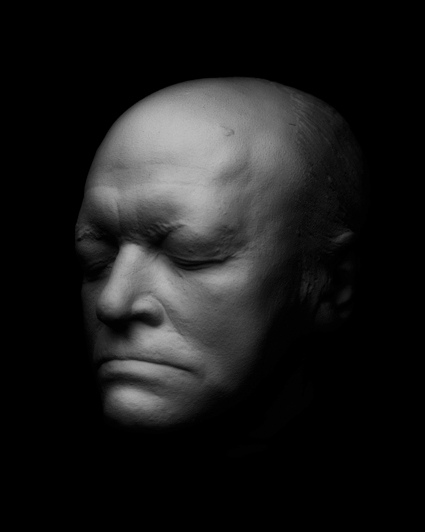
Blake

William Blake, 1757-1827, life mask made in 1823: photo by Joanna Kane, from The Somnambulists, 2008 (via Creative Review)

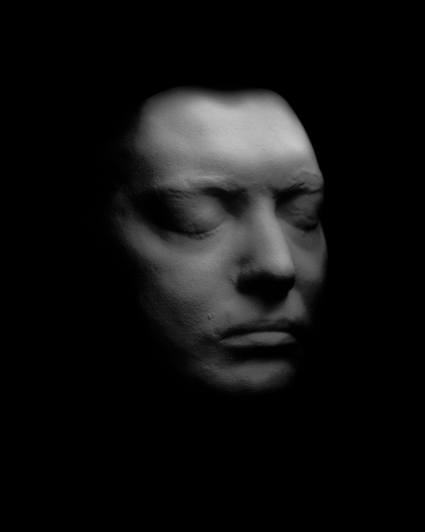
Unknown Woman

Life [?] or death [?] mask of Unknown Woman: photo by Joanna Kane, from The Somnambulists, 2008 (via Creative Review)

Keats

John Keats, 1795-1821, life mask: photo by Joanna Kane, from The Somnambulists, 2008 (via Creative Review)

Princess

Life [?] or death [?] mask of Princess Tolstoya, 1800-1873: photo by Joanna Kane, from The Somnambulists, 2008 (via Creative Review)

Wordsworth

William Wordsworth, 1770-1850, life mask made in 1815: photo by Joanna Kane, from The Somnambulists, 2008 (via Creative Review)

Cautious Woman

[Life mask of] Unknown Woman, a "cautious type" i.e. possibly suicidal: photo by Joanna Kane, from The Somnambulists, 2008 (via Creative Review)

Coleridge

Samuel Taylor Coleridge, 1772-1834, life mask: photo by Joanna Kane, from The Somnambulists, 2008 (via Creative Review)

Ghosts (Yeats: The Mask)


.

http://upload.wikimedia.org/wikipedia/commons/6/60/Topeng_Bali.jpg


Various Balinese Topeng (dance masks), Taman Mini Indonesia Indah, Jakarta
: photo by Gunawan Kartapranata, 2009


There is an unconscious propriety in the way in which, in all European languages, the word person is commonly used to denote a human being. The real meaning of persona is a mask, such as actors were accustomed to wear on the ancient stage; and it is quite true that no one shows himself as he is, but wears his mask and plays his part. Indeed, the whole of our social arrangements may be likened to a perpetual comedy; and this is why a man who is worth anything finds society so insipid, while a blockhead is quite at home in it.

Arthur Schopenhauer: Psychological Observations, from Studies in Pessimism in Parerga und Paralipomena, 1851 (translated by Thomas Bailey Saunders)


W. B. Yeats: The Mask


"Put off that mask of burning gold

With emerald eyes."
"O no, my dear, you make so bold

To find if hearts be wild and wise,
And yet not cold."


"I would but find what's there to find,
Love or deceit."

"It was the mask engaged your mind,
And after set your heart to beat,
Not what's behind."


"But lest you are my enemy,
I must enquire."

"O no, my dear, let all that be;
What matter, so there is but fire
In you, in me?"

The Mask: W. B. Yeats, from The Green Helmet and Other Poems, 1912


Face masks of Prince William and Kate Middleton are loaded into boxes for shipping at a production plant in Southam, England; by a week before the ceremony over 120,000 of the masks had been sold worldwide with Mask-arade company staff working around the clock to complete orders before the royal wedding: photo by Martin Cleaver/Associated Press, 22 April 2011

File:Bodiemask.jpg

Mask found in window of Bodie, California ghost town school house: photo by Tahoenathan, 2009

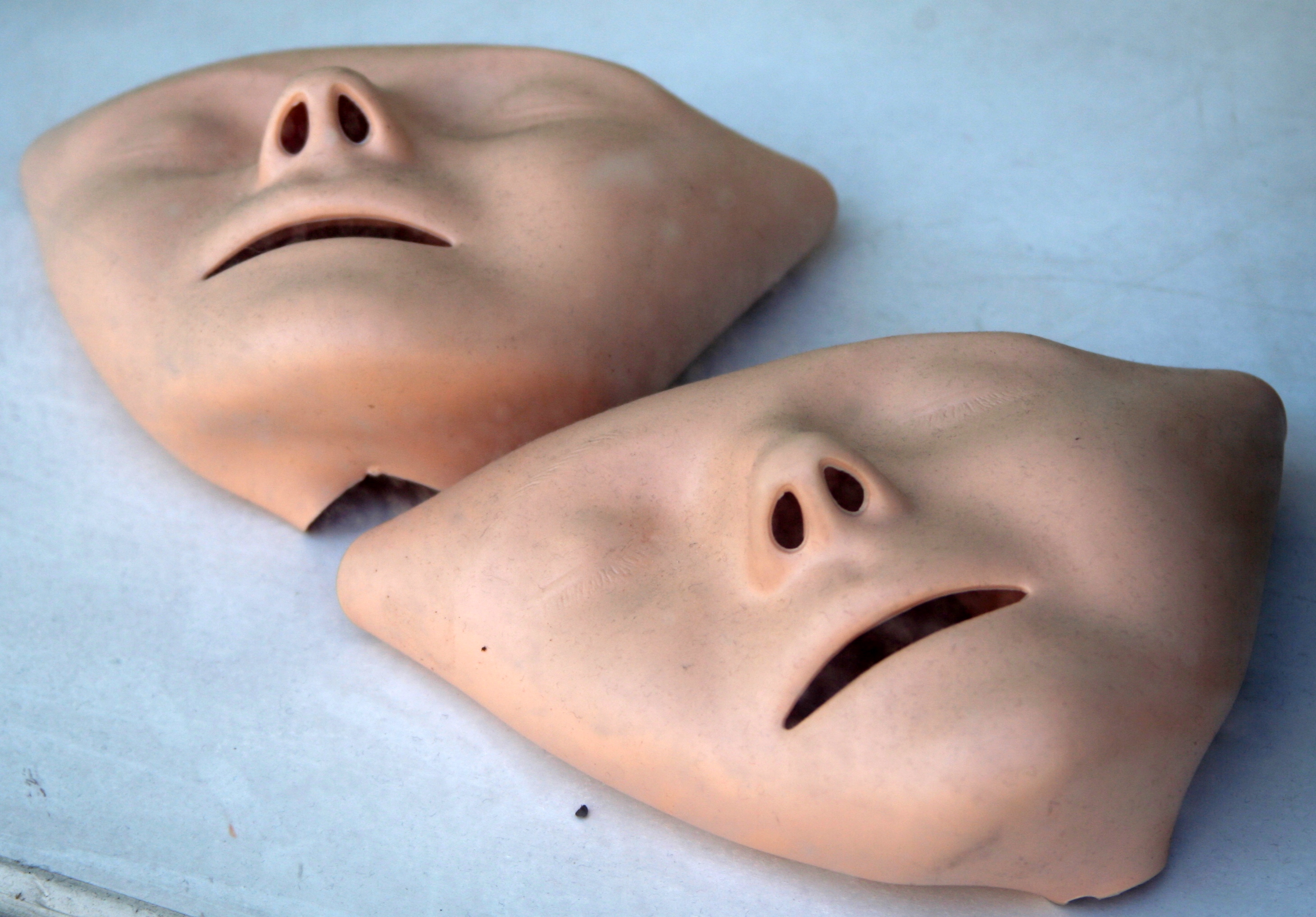
File:First aid masks for CPR training.jpg

Masks in showcase of first aid supplies shop, Berlin: photo by Till Krech, 2006

MaskTV: photo by James Reynolds, 2006